"...the cliffs of England stand, / Glimmering and vast, out in the tranquil bay." (Lines 4 - 5)
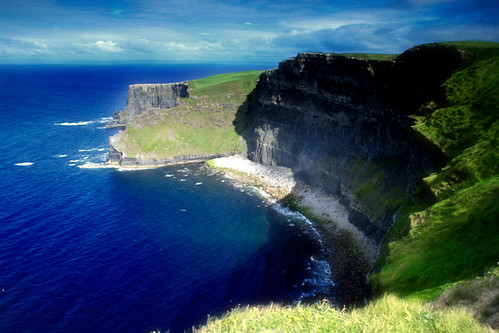
The imagery in this poem is very clear and concise. The speaker sees beauty and describes it. I can practically see the water washing onto the shore. The speaker has a precise image of what he wants to reveal to the reader, and he wants the reader to share in his love of the beauty that is this earth. However, there is a twist! Gasp! This earth is lovely, and it has been adored by Sophocles in the past. However, it is devoid of the feeling of love. It does not know the emotions that the speaker feels, and he is sorry for it. He wants his love to feel the same way he does for the sea and its extravagance, but he also wants her to realize that they are lucky in their love. They get to experience this great thing that has been provided for their enjoyment. I have this image in my head of the Cliffs of Moher in Ireland. I have seen them ateast twice, and there is nothing on earth to compare there unique beauty to. They simply drop off into the depths of the luscious sea, and they are breathtaking! Here they are:
Showing posts with label Imagery. Show all posts
Thursday, September 29, 2011
Friday, August 12, 2011
Imagery - Can't you just see it?
"Cloaks of turkey feathers fluttered from their shoulders; huge feather diadems exploded gaudily round their heads." (Page 109)
What a scene! For the entire lives of Lenina and Bernard, order has been the only thing they knew. It ran their lives, and they were comfortable with that. And then, BAM! All of a sudden, they are thrust out of their world and into one with color and disorder. One with spontaneity and true emotion. It is only fitting that I chose this scene to highlight Huxley's knack for imagery. He couldn't have fully written the scene without pulling out all of the stops and plowing full-speed ahead with his power verbs and eccentric adjectives. This sentence is only one of many that he hand-crafted to adorn this scene. From "the clink and rattle of their silver bracelets" to the old man's skin that was "wrinkled and black, like a mask of obsidian," Huxley gave his reader's imagination a literary treat.
Friday, July 8, 2011
Imagery - Spare me the details
"You could see bits of skin starting to bond, and soft red bits peeping up from underneath." (Page 85)
Yuck. Why on earth would I want to picture this? Thank God I have a strong stomach because Ishiguro busted out the imagery when describing Tommy's gash on his elbow. Imagery is supposed to enhance the images we picture while reading whether they be lovely or gruesome. Well, Ishiguro did well. I imagined that healing gash on poor Tommy's elbow. (Which is exactly what the author wanted by the way.) Without this accurately sick description, I wouldn't fully grasp the story. Nor would I remember this specific scene.
In addition to its enduring qualities, imagery simply makes the story better, more real. There is a big difference between "the cut" and "the blood-oozing gash." Sorry to upset your stomach with my flawless spinning of the macabre words, but it had to be done.
Yuck. Why on earth would I want to picture this? Thank God I have a strong stomach because Ishiguro busted out the imagery when describing Tommy's gash on his elbow. Imagery is supposed to enhance the images we picture while reading whether they be lovely or gruesome. Well, Ishiguro did well. I imagined that healing gash on poor Tommy's elbow. (Which is exactly what the author wanted by the way.) Without this accurately sick description, I wouldn't fully grasp the story. Nor would I remember this specific scene.
In addition to its enduring qualities, imagery simply makes the story better, more real. There is a big difference between "the cut" and "the blood-oozing gash." Sorry to upset your stomach with my flawless spinning of the macabre words, but it had to be done.
Subscribe to:
Posts (Atom)